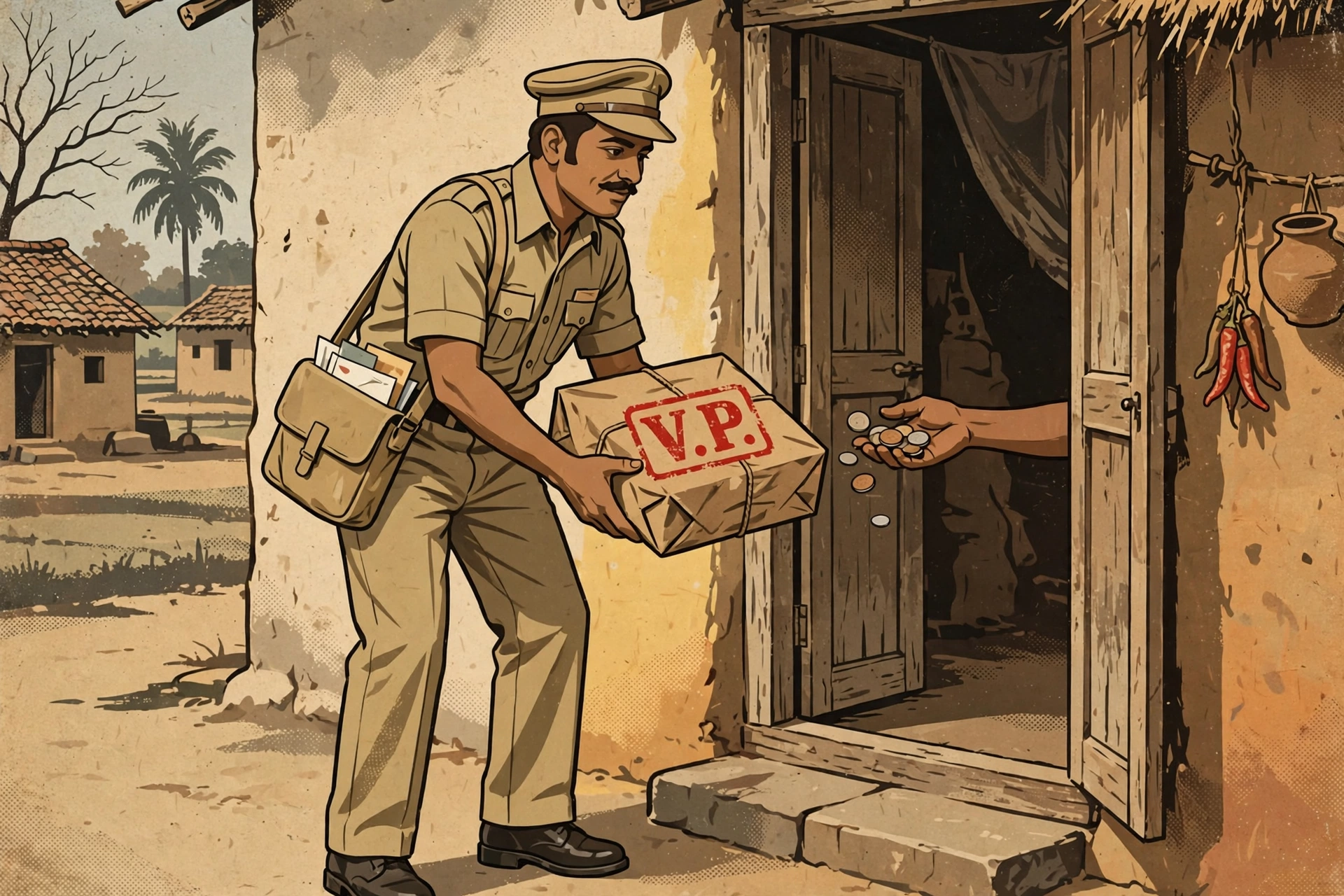
Long before “cash on delivery” became a checkout option on e-commerce apps, India had VPP in post office branches everywhere — Value Payable Post, the country’s original cash-on-delivery system. A buyer ordered goods through a newspaper advertisement, the seller posted a “VP”-marked parcel, and the postman delivered it and collected the price in cash at the doorstep. This guide explains what VPP is, how a genuine VPP parcel is sent and received, what changed under the 2024 postal rules — plus the 2026 scam warning.
What is VPP in post office? India’s original cash-on-delivery
VPP stands for Value Payable Post. It served two needs: buyers who wanted to pay on receipt, and traders who wanted the Post Office to recover the value of goods supplied — cash on delivery, decades before the phrase existed in Indian retail.
The heritage version worked like this. Publishers and small manufacturers advertised in newspapers and magazines; a reader in a village ordered by postcard to a Post Box number; the seller posted the item as a VPP parcel; and the postman delivered it sealed, collecting the marked price in cash on the spot. Readers still recall buying Delhi publishers’ books exactly this way — in areas private couriers never reached, VPP was the only way strangers could trade without either side carrying the whole risk.
How a genuine VPP article worked, step by step
The mechanics were simple — and the scam version copies them:
- The sender posts a registered article, declares a “value payable” amount, and fills the VP money-order form at the counter.
- The postman collects that amount in cash from the recipient at delivery. The parcel is sealed — contents cannot be inspected before paying.
- The recipient may refuse the parcel. Refusal was always free; the addressee simply said no, and the article went back.
- India Post remitted the collected sum to the sender, completing the transaction.
Unlike courier cash-on-delivery (settled through the courier’s own system), the post office version ran through the money-order network and reached pin codes couriers never served. But one design feature carried over: the recipient could never examine the goods before paying — harmless in the newspaper-advert era, and exactly what fraudsters weaponised in 2026.
VPP in post office after the 2024 rules: merged into Cash on Delivery
Here is the fact most websites get wrong: VPP as a standalone product was merged with Cash on Delivery under the Post Office Rules and Regulations 2024 (G.S.R. 767(E), in force from 16 December 2024 under the Post Office Act 2023). The Department of Posts’ circular to all circles says it plainly — “Value Payable Post has been merged with Cash on Delivery” with COD extended to retail customers too.
So the idea survives as the Cash on Delivery product, open to retail customers. Ask about “VPP” at the counter today and you will likely be guided to COD — the old term lives on in common speech and, tellingly, in scam scripts. Confirm current fees and limits on the official India Post website or at the counter.
How to send a VPP (now COD) parcel: the sender’s checklist
The classic VP booking rules in the Post Office Guide still show exactly how a value-payable article was prepared — and the merged COD product follows the same logic. New to post office bookings? Read our parcel booking guide first. The checklist, verified against the published rules:
- Use a money-order office. Value payable articles moved between money-order offices — confirm your booking office handles COD articles.
- Register the article. Only registered articles qualified: parcels, letters, book packets and prepaid newspapers. See how registered post differs from speed post before choosing the right base service.
- Write “VP” on the face in the upper left-hand corner, followed by the amount to be collected — in both figures and words. Your own name and full address go in the lower left-hand corner.
- Declare the bona fide order. The sender had to declare the article was sent against a genuine order from the addressee — unsolicited goods could not use this channel legitimately.
- Fill the VP money-order form and take your receipt. The form carries the sum to be remitted; the receipt is your proof of booking.
The old rulebook capped the remittance at ₹5,000 per article. The 2024 rationalisation may have revised limits and fees — confirm the current cap and COD charge at the counter or on indiapost.gov.in. No fee figures are published here that cannot be verified on an official source.
The 2026 VPP scam warning: the one rule that matters
VPP is legitimate — but in 2026 it became one of India’s busiest doorstep frauds. Scammers post unsolicited sealed packets disguised as government notices, prize parcels or religious literature, demanding ₹500 to ₹5,000 cash before contents can be examined. Documented 2026 variants:
- Fake GST, Income Tax or MCA compliance kits targeting small businesses and new companies in government-adjacent packaging. One long-running variant targets new directors with printed DIN letters or junk booklets — free from the MCA website — demanding hundreds or thousands of rupees.
- Lottery and prize-claim parcels with a “winner certificate” and a ₹500–₹1,500 “processing charge” for a prize that does not exist.
- Religious literature for senior citizens — small-ticket packets from fabricated trusts that the elderly are unlikely to refuse.
- The layered QR-code variant: the doorstep payment is only the first layer. Inside, a letter asks you to scan a QR code to “complete registration” or “avoid penalties” — it opens a phishing page harvesting Aadhaar, PAN, bank and OTP details. The ₹1,000 at the door becomes the entry point to a far larger bank fraud.
The absolute rule: no Indian regulatory authority — Income Tax, CBIC, RBI, SEBI, MCA, EPFO or ESIC — will ever send you a packet carrying a Value Payable Post charge. Government bodies use speed post or registered post (free to you), official email, or their own portals — never doorstep cash. A packet demanding payment in a government body’s name is fraudulent, without exception.
What to do when a suspicious VPP arrives at your door
The entire defence is one protocol: ask the postman for the sender’s full name and address (it must be printed on the packet); if you are not expecting a paid parcel from that sender, refuse it: “I am refusing this delivery — please mark it as refused by addressee.” Refusal is routine and free. Never call a “helpline” printed on the packet or scan any QR code inside it — both belong to the scammer. And never pay first to “investigate later”: once cash is handed over and receipted, remittance to the sender begins within hours and recovery is almost never possible.
Then report: pgportal.gov.in (India Post grievance), cybercrime.gov.in, and the National Cyber Crime Helpline 1930 — within hours, not days, if you already paid. Impersonation of a government body can also go to your local police station. To follow a genuine complaint, see how to check your India Post complaint status online.
Frequently asked questions about VPP in post office
What is the full form of VPP in post office?
Value Payable Post — India’s original cash-on-delivery service: the postman collected a declared cash amount at delivery and India Post remitted it to the sender.
Can I still send a VPP parcel in 2026?
Yes, under a new name. The Post Office Rules 2024 merged VPP into Cash on Delivery, now open to retail customers as well as businesses. Ask for the COD product at any money-order-capable post office.
What is the maximum amount I can send through VPP?
The classic rules capped it at ₹5,000 per article, but the 2024 rationalisation may have changed this — confirm the current cap and charge at the counter or on indiapost.gov.in.
Is VPP a scam?
No — it is a legitimate service that scammers misuse. Safest rule: never pay for a VPP packet you did not order. And no government body will ever send one — an “official” VPP packet is fraudulent by definition.
The postman is asking for money for a parcel I never ordered. What should I do?
Ask for the sender’s name and address, then refuse — refusal is free and routine. Don’t pay to “check contents”, don’t call numbers printed on the packet, and report at pgportal.gov.in, cybercrime.gov.in, or 1930.