How to Pack a Parcel for Courier: Complete Guide (2026)
Knowing how to pack parcel for courier correctly is the single biggest factor in whether your shipment arrives in one piece. Couriers handle thousands of parcels a day — boxes get stacked, loaded, unloaded, and moved through sorting hubs — so your packaging has to survive real-world handling, not just a gentle car ride. The good news is that proper packing is a skill anyone can learn in a few minutes.
This complete guide walks you through every step: choosing the right box, cushioning materials, wrapping fragile items, sealing, labelling, and what you should never pack.
How to Pack Parcel for Courier: Choose the Right Box
Start with the outer container, because everything else depends on it.
Use a new, rigid corrugated box. Old boxes lose strength each time they are reused — the flaps weaken and the corners crush. For anything valuable or fragile, a fresh double-wall corrugated box is worth the small cost.
Size it right. The box should be slightly larger than your item, leaving about 5 cm of space on all sides for cushioning. Too big, and the item will shift and slam around; too small, and there is no room for protective padding. If you are shipping an item in its original retail box, place that box inside a slightly larger outer shipping box (“double boxing”) for extra protection.
Match the box to the weight. Heavy items need stronger boxes. As a rough rule, single-wall corrugated boxes suit lighter parcels, while double-wall boxes handle heavier or fragile contents. If the item is very heavy (books, machine parts), consider whether it needs a reinforced or wooden-crated package — and check with your courier about weight limits first.
Cushioning Materials: What to Use Inside
Cushioning absorbs shocks and stops items moving inside the box. You have several good options:
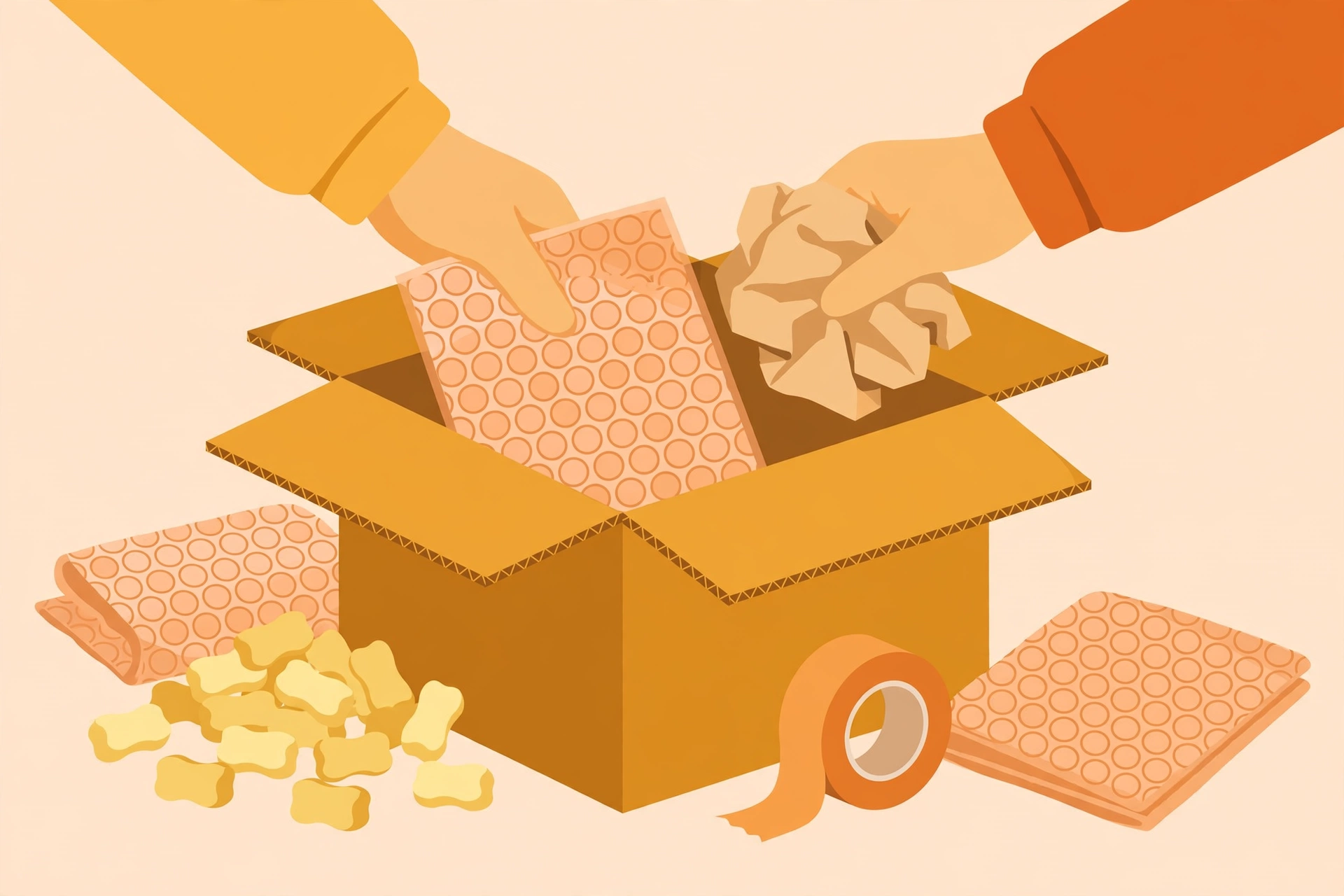
Bubble wrap is the best all-rounder for fragile items — wrap each item individually with the bubbles facing inward, and secure with tape. Foam sheets and foam pouches work well for flat or delicate surfaces like photo frames and electronics screens. Crumpled kraft paper or newspaper is a cheap, effective filler for filling empty space around sturdy items. Air pillows and packing peanuts are excellent void fillers that keep items centred in the box.
Avoid using only soft materials like clothes or towels as the sole cushioning for genuinely fragile items — they compress under stacking weight and stop protecting. And never leave empty space: an item that can move inside the box will eventually break itself against the walls.
For a quick test, close the box and shake it gently. If you feel or hear movement, add more filler. A well-packed parcel should feel solid and silent. This shake test is the easiest way to double-check how to pack parcel for courier safely.
How to Pack Parcel for Courier: Wrapping Fragile Items
Fragile items — glassware, ceramics, electronics, bottles — need individual attention before they go in the box:
Wrap each piece separately in bubble wrap, securing it with tape so it cannot unwrap in transit. Items packed together without separation will knock against each other and chip or crack.
- Protect the most vulnerable points. For bottles, pad the neck and base; for frames, protect the corners with cardboard corner guards or extra wrap; for electronics, cover screens with a foam sheet first.
- Use dividers for multiple items. Cardboard dividers (like those in wine boxes) keep bottles and jars from touching each other.
- Centre the item in the box. Surround it with at least 5 cm of cushioning on all six sides — the item should never touch the box walls directly.
- Mark the box. Write “FRAGILE” and “THIS SIDE UP” clearly on multiple faces. Markings help, though they are no substitute for good internal packing — pack as if the box will be handled roughly anyway.
Sealing Your Parcel Properly
Weak sealing is one of the most common reasons parcels open in transit. Use proper pressure-sensitive packing tape (at least 5 cm wide) — not masking tape, cello tape, or string, which can snap or peel.
Seal using the H-tape method: run tape along the centre seam where the flaps meet, then across both edges, forming an “H” on the top and bottom of the box. This reinforces the weakest points. For heavy parcels, add a second layer of tape or strap the box.
If your box has old labels, barcodes, or markings from previous use, remove or fully cover them — stray barcodes can confuse sorting scanners and misroute your parcel.
Labelling: Sender and Recipient Addresses
A clearly labelled parcel is far less likely to be delayed or lost. Write or print the addresses in clear block letters:
Recipient (TO): full name, complete street address with landmark, city, state, and the correct 6-digit PIN code. Include the recipient’s mobile number — couriers routinely call it for delivery coordination.
Sender (FROM): your full name, address, and mobile number, placed in a corner or on the opposite side. This is essential: if the parcel cannot be delivered, the courier needs a return address.
Place the main address label on the largest flat face of the box, and consider putting a duplicate label inside the box as a backup. If the outer label is torn off, the inner copy can still get your parcel delivered. For extra safety, you can also write the destination PIN code in large digits on two sides of the box.
For official postal guidance on addressing and packing standards, see the India Post official website.
What Not to Pack: Prohibited and Restricted Items
Before you seal the box, make sure the contents are allowed. Couriers and postal services prohibit or restrict items such as explosives, flammable liquids and gases, corrosive chemicals, perishable food without proper packaging, live animals or plants (with limited exceptions), cash and high-value negotiables, and weapons. Restrictions vary between couriers and between domestic and international services.
Sending a prohibited item can lead to the parcel being confiscated, destroyed, or returned at your cost — and in serious cases, legal consequences. When in doubt, check the courier’s prohibited-items list before booking. If you are comparing postal services for your shipment, our Speed Post vs Registered Post guide explains which service suits different parcel types, and our India Post parcel charges page covers indicative pricing. Knowing how to pack parcel for courier also means knowing what never to put in the box.
Final Checklist Before Handover
Run through this quick checklist at the courier counter:
Right-sized rigid box, item cushioned on all six sides, no movement when shaken, sealed with the H-tape method, old labels removed, clear TO and FROM addresses with PIN code and mobile numbers, duplicate label inside, “FRAGILE” marked if needed, and contents confirmed as permitted. Then get your booking receipt and keep the tracking number safe — you can follow the shipment on our package tracker page. Once you know how to pack parcel for courier properly, this whole checklist takes just a few minutes.
FAQs
How to pack parcel for courier without a proper box?
A rigid corrugated box is strongly recommended. In a pinch, a sturdy unused carton reinforced with extra tape can work for light, non-fragile items — but avoid thin shoeboxes or damaged cartons, as they crush easily under stacking.
Can I use newspaper as packing material?
Yes, crumpled newspaper is a decent, low-cost filler for sturdy items and filling void space. For fragile items, pair it with bubble wrap around the item itself — newspaper alone compresses too much under stacking weight.
Should I write FRAGILE on the box?
Yes, mark “FRAGILE” and “THIS SIDE UP” clearly on multiple faces. But treat markings as a bonus, not protection — always pack the inside as if the parcel will be handled roughly.
Do I need to put my own address on the parcel?
Yes. Always include the sender’s full name, address, and mobile number. Without a return address, an undeliverable parcel cannot be sent back to you.
Can I pack electronics for courier shipping?
Yes. Power them off, remove batteries if the courier requires it, wrap the device in anti-static bubble wrap or foam, cushion on all sides, and double-box valuable items. Check your courier’s rules on lithium batteries before booking. If you are still learning how to pack parcel for courier, practise on sturdy items before moving to electronics.