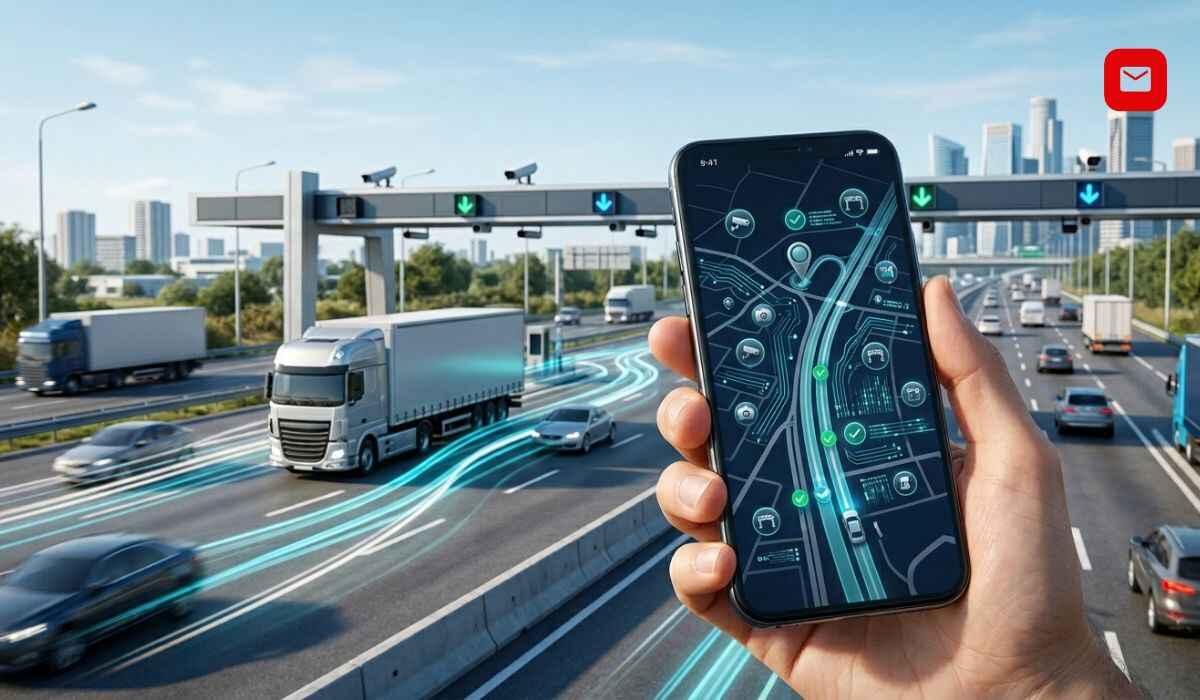
Toll tracking in India is the system that monitors every toll payment, FASTag deduction, balance status, and transaction history for any vehicle traveling on national highways and expressways managed by the National Highways Authority of India (NHAI), enabling drivers, fleet operators, and logistics companies to follow every rupee spent at every toll plaza in real time through the FASTag RFID system, the Rajmargyatra app, bank SMS alerts, and the NHAI Toll Information System portal.
With over 1,000 active toll plazas across India’s 480-plus toll roads, FASTag mandatory since January 2021 for all four-wheelers and above, and a new zero-cash policy eliminating dedicated cash lanes, understanding toll tracking is now essential for every vehicle owner in India.
This complete guide covers how FASTag toll tracking works, how to check your FASTag balance and transaction history, the GNSS-based toll system rolling out for commercial vehicles, the FASTag Annual Pass, vehicle class rates, and everything you need to know about avoiding penalties and blacklisting at toll plazas.
What Is Toll Tracking in India?
| Detail | Information |
|---|---|
| System Name | FASTag Electronic Toll Collection (ETC) |
| Governing Body | NHAI and IHMCL (Indian Highways Management Company Ltd) |
| Payment Processor | National Payments Corporation of India (NPCI) |
| Technology | RFID, ANPR cameras, AI, IoT, cloud computing |
| Total Toll Plazas | 1,000 plus across India |
| Highways Covered | 480 plus toll roads nationwide |
| FASTag Mandatory From | January 1, 2021 for all Class M and N vehicles |
| Issuing Banks | 26 certified banks |
| NHAI Helpline | 1033 |
| Official App | Rajmargyatra (Android and iOS) |
| Balance Check Missed Call | +91-8884333331 |
Toll tracking refers to the complete system of recording, monitoring, and managing toll payments across India’s national highway network. At its core, this system is driven by FASTag, an RFID-based electronic toll collection technology that automatically deducts the applicable toll fee from a linked wallet or bank account as a vehicle passes through a toll plaza without stopping.
Every FASTag transaction creates a digital record including the date, time, toll plaza name, vehicle registration number, amount deducted, and remaining balance. This data trail makes modern toll tracking possible for individual drivers, businesses, and fleet managers.
How FASTag Toll Tracking Works
The FASTag system uses a combination of technologies to identify vehicles, calculate the applicable toll, deduct the payment, and update the transaction record in real time.
The Step-by-Step Process at Every Toll Plaza
Step 1: Vehicle Approaches. When a vehicle approaches the toll booth, its RFID tag is scanned by a reader. At the same time, an ANPR camera captures an image of the license plate.
Step 2: Dual Verification Both pieces of data are sent to a central cloud server, where AI checks if the RFID tag details match the vehicle’s registration and category. This dual verification using both RFID and license plate recognition prevents misuse and ensures accurate vehicle classification.
Step 3: Automatic Deduction If everything matches, the toll amount is automatically deducted from the linked FASTag wallet. The vehicle passes through the barrier without stopping.
Step 4: Fallback System If the RFID tag is not read properly or the vehicle does not have one, the system relies on the license plate captured by the camera to identify the vehicle, calculate the toll fee, and either recover payment or trigger alerts. This ANPR fallback ensures that no vehicle passes without being recorded.
Step 5: Record Creation Local processing nodes at the toll plaza quickly make decisions, while cloud-based analytics store and synchronize data across all points for future reference, monitoring, and traffic reports. Every transaction is permanently recorded.
How to Track Your FASTag Toll Transactions
Method 1: Rajmargyatra App
The Rajmargyatra app is the official NHAI-IHMCL app for FASTag management and toll tracking. Available on both Android and iOS, it allows you to check your FASTag balance, view transaction history, find toll plaza rates along any route, manage your FASTag wallet, and purchase the FASTag Annual Pass.
Download steps: Search for Rajmargyatra on the Google Play Store or Apple App Store, install the app, log in with your registered mobile number, and access your complete FASTag transaction history from your dashboard.
Method 2: SMS Alerts
Every FASTag transaction triggers an automatic SMS to your registered mobile number. The SMS contains the toll plaza name, the deduction amount, the transaction timestamp, and the remaining balance after the deduction.
Enable SMS alerts by ensuring your mobile number is registered and active with your FASTag issuing bank. Contact your bank’s FASTag customer care or visit your bank’s FASTag portal to verify your registered mobile number.
Method 3: Missed Call Balance Check
Users who have registered their mobile number with the NHAI Prepaid Wallet can check their balance by making a missed call to +91-8884333331. The number is toll-free and the facility is available round the clock. This is the fastest way to check balance without opening any app.
Method 4: NHAI Toll Information System
Visit tis.nhai.gov.in, the official NHAI Toll Information System portal, to access toll plaza information, transaction records, and account status for registered users.
Method 5: Bank FASTag Portals and Apps
Each of the 26 certified FASTag-issuing banks provides its own app or portal for FASTag management. Banks including SBI, HDFC, ICICI, Axis, Kotak, Paytm Payments Bank, Airtel Payments Bank, and others provide dedicated FASTag sections within their existing banking apps where customers can track all transactions and manage balances.
Method 6: My FASTag App (NHAI)
The My FASTag App is available on both Android and iOS platforms. It provides a step-by-step process for FASTag activation, linking to a bank account, and setting up auto-top-up for uninterrupted toll payment. Users with an NHAI FASTag who have linked their tag to a bank account can receive real-time transaction notifications and manage their account entirely through this app.
Method 7: UPI-Based Tracking
The FASTag UPI ID format is NETC.VehicleRegistrationNumber@CustomerBankUPIHandle. You can recharge through 100 plus UPI-enabled apps like Paytm, Google Pay, and PhonePe. Most UPI apps maintain a complete transaction history, including FASTag recharges, making them a secondary source for tracking toll-related payments.
FASTag Vehicle Classification and Toll Rates
Toll rates in India are based on the vehicle’s size, axle count, and weight. Different vehicle categories pay different toll amounts at the same plaza.
| Category | Vehicle Types | Rate Multiplier |
|---|---|---|
| Category 1 | Cars, Jeeps, Vans, LMV | Base rate |
| Category 2 | LCV, Light Goods Vehicles, Mini-Buses | Higher than Category 1 |
| Category 3 | 2-Axle Trucks and Buses | Higher than Category 2 |
| Category 4 | 3-Axle Commercial Vehicles | Higher than Category 3 |
| Category 5 | 4 to 6 Axle Multi-Axle Vehicles | Higher than Category 4 |
| Category 6 | Heavy Construction Equipment | Higher than Category 5 |
| Category 7 | Oversized Vehicles | Highest rate |
| Two-Wheelers | Motorcycles and Scooters | Generally exempt at NHAI plazas |
Rates are revised annually effective April 1 each year based on the Wholesale Price Index. GST exemption applies, meaning toll charges are exempt under Notification 12/2017-Central Tax. The FASTag deduction is the complete net toll with no additional tax.
FASTag Annual Pass: Complete Guide
The FASTag Annual Pass is a toll payment option introduced for non-commercial private vehicles including cars, vans, and jeeps. It allows seamless travel for one year or up to 200 trips at NHAI plazas, whichever comes earlier.
| Feature | Details |
|---|---|
| Price | Rs 3,075 for one year or 200 trips |
| Eligible Vehicles | Non-commercial private vehicles (cars, vans, jeeps) |
| Activation Time | Within 2 hours of payment |
| Valid At | 1,150 plus NHAI toll plazas |
| Users Enrolled | 56 lakh plus |
| Effective Toll Per Trip | Rs 15 to Rs 20 versus Rs 70 to Rs 80 without pass |
| Distance-Based Option | Rs 50 per 100 km alternative |
| Purchase Platform | Rajmargyatra App or NHAI website |
With 56 lakh plus users enrolled, the Annual Pass is worth buying for anyone who regularly travels on national highways. The pass is most cost-effective for frequent highway commuters who make more than 40 trips per year, as the effective per-trip rate of Rs 15 to Rs 20 represents a significant saving compared with the standard Rs 70 to Rs 80 per-trip average.
How to Purchase the FASTag Annual Pass
Step 1: Ensure your vehicle has an active FASTag attached to the windshield and linked to your vehicle registration number.
Step 2: Download the Rajmargyatra App or visit the NHAI website.
Step 3: Select FASTag Annual Pass and pay Rs 3,075.
Step 4: The pass activates within 2 hours after payment and verification. An SMS confirmation is sent to your registered mobile.
Step 5: When you pass through any NHAI toll plaza, the RFID scanner reads your FASTag and deducts one trip from your 200-trip limit instead of charging the standard toll amount.
GNSS-Based Toll Tracking: The Next Generation
India is currently rolling out a GPS-based toll collection system known as GNSS (Global Navigation Satellite System), which represents a fundamental shift from plaza-based toll collection to distance-based automatic toll deduction.
GNSS-equipped vehicles have dedicated lanes at existing plazas during the transition period. The toll is automatically debited based on the exact distance traveled on toll roads rather than fixed amounts at each plaza. FASTag infrastructure continues alongside GNSS during a multi-year transition.
The current rollout is focused on commercial vehicles with existing Vehicle Location Tracking (VLT) systems. Private vehicles are expected to follow during the period covering 2026 and 2027. Full replacement of FASTag by GNSS On-Board Units (OBUs) for private vehicles is expected over several years.
GNSS toll tracking offers significant advantages for fleet operators and logistics companies because:
- Toll cost becomes precisely proportional to distance driven on toll roads
- There are no plaza-specific charges or rounding differences between routes
- GPS-based tracking data provides fleet-wide route analytics beyond just toll payments
- Commercial vehicles with existing VLT systems require only minimal additional hardware
Penalties for FASTag Violations
Understanding the penalty structure is essential for avoiding avoidable costs and blacklisting.
| Violation | Penalty |
|---|---|
| No FASTag (cash lane or FASTag lane) | 2x the applicable toll |
| FASTag lane without valid FASTag | 2x the applicable toll |
| UPI payment without FASTag | 1.25x the applicable toll (effective late 2025) |
| Insufficient balance (blacklisted tag) | 2x the applicable toll charged on the spot |
| Wrong vehicle class FASTag | 2x the applicable toll |
The e-notice system from March 17 onwards means unpaid toll violations trigger SMS and email e-notices with 3 days to pay or dispute before further legal action and potential registration blacklisting.
What Causes FASTag Blacklisting
Blacklisting triggers include insufficient balance, expired KYC, or registration mismatch. A blacklisted vehicle cannot transact at any NHAI plaza until the issue is resolved. There is a 70-minute grace period window to recharge a blacklisted tag before reaching the next plaza under NPCI rules.
How to Avoid Toll Tracking Problems
Maintain Sufficient Balance
Enable SMS alerts on your FASTag wallet and keep approximately Rs 500 buffer above your estimated trip toll to avoid blacklisting mid-journey. If you are using the Rajmargyatra app, set up auto-top-up by linking a bank account or UPI to maintain balance automatically.
Complete Your KYC
Expired KYC is one of the most common and easily avoidable causes of FASTag blacklisting. Verify your KYC status through your issuing bank’s FASTag portal or the Rajmargyatra app before any long highway journey.
Verify Vehicle Registration Details
Ensure the vehicle registration number linked to your FASTag exactly matches the number plate on your vehicle. Registration mismatches trigger blacklisting and double-toll charges at every plaza until resolved.
Use the Rajmargyatra App Before Long Journeys
Before any significant highway journey, use the Rajmargyatra app to check your FASTag balance, identify all toll plazas along your planned route with their applicable rates, and calculate the total toll cost. Maintain your balance above that total plus the recommended Rs 500 buffer.
Toll Tracking for Fleet Managers and Logistics Companies
For businesses operating vehicle fleets, toll tracking is a critical component of transportation cost management and route optimization.
FASTag Fleet Management
Each FASTag is vehicle-specific and linked to a single vehicle registration number. Businesses operating multiple vehicles can link each FASTag to a corporate account or dedicated fleet FASTag wallet, allowing centralized billing and consolidated transaction reports across the entire fleet.
Many fleet management platforms now integrate directly with NETC FASTag APIs to automatically pull transaction data, creating unified reports showing toll expenditure per vehicle, per route, and per period.
GNSS for Commercial Fleets
The ongoing GNSS rollout is specifically prioritizing commercial vehicles with existing VLT systems. Fleet operators who adopt GNSS-compatible OBUs gain distance-proportional toll tracking that integrates with existing GPS fleet management systems, providing more granular route cost data than plaza-based FASTag alone.
Route Optimization Using Toll Data
Historical toll transaction data from FASTag reveal actual route patterns, transit times between plazas, and total toll costs per route. Fleet managers can use this data to compare alternative routes, identify toll-heavy corridors where routing adjustments would reduce costs, and validate that drivers are using authorized routes.
Complete Toll Tracking Contact Directory
| Contact Method | Details | Purpose |
|---|---|---|
| NHAI Helpline | 1033 | FASTag issues, toll complaints, general NHAI queries |
| Balance Missed Call | +91-8884333331 | Instant balance check |
| Rajmargyatra App | Android and iOS | Full FASTag management and tracking |
| My FASTag App | Android and iOS | NHAI FASTag activation and linking |
| NHAI Toll Info System | tis.nhai.gov.in | Toll plaza information and transaction history |
| NHAI Official Website | nhai.gov.in | Policies, Annual Pass, official announcements |
For bank-specific FASTag issues, contact your issuing bank’s customer care. The FASTag complaint number for NHAI-level escalations is 1033.
Return Journey Discount
Most NHAI toll plazas offer a discounted return rate if the return journey occurs within 24 hours of the outward trip. The return trip within 24 hours costs only 1.5 times the single-trip rate. This means that if you travel both ways on the same day, your total toll expenditure is 2.5 times the single-way toll, rather than 2x.
Plan same-day return journeys accordingly and factor this discount into your toll budget calculations.
Frequently Asked Questions About Toll Tracking
What is toll tracking in India?
Toll tracking in India refers to the monitoring of all toll payments, FASTag deductions, and transaction history for vehicles traveling on NHAI national highways. Every FASTag transaction creates a digital record including the toll plaza, amount, timestamp, and balance. Drivers track these transactions through the Rajmargyatra app, SMS alerts, bank portals, and the NHAI Toll Information System at tis.nhai.gov.in.
How do I check my FASTag transaction history?
Open the Rajmargyatra app (official NHAI app) or your FASTag-issuing bank’s app. Log in with your registered mobile number and access the transaction history section. You can also check transactions through the My FASTag App or by contacting your bank’s FASTag customer care.
What is the FASTag balance check missed call number?
Give a missed call at +91-8884333331 to check your FASTag balance instantly. This toll-free service is available around the clock for users who have registered their mobile number with NHAI Prepaid Wallet.
What happens if my FASTag has no balance at a toll?
If your FASTag has insufficient balance, the tag gets blacklisted and you must pay 2x the applicable toll in cash. A 70-minute grace period allows you to recharge a blacklisted tag before reaching the next plaza. Keep a minimum Rs 500 buffer above your estimated trip toll at all times.
What is the FASTag Annual Pass?
The FASTag Annual Pass is a Rs 3,075 pass for non-commercial private vehicles that covers 200 toll crossings or one year at 1,150 plus NHAI plazas, whichever comes first. The effective per-trip toll cost drops to Rs 15-20 from the standard Rs 70-80, making it cost-effective for anyone taking more than 40 highway trips per year.
Is FASTag mandatory in India?
Yes. FASTag has been mandatory for all Class M and N vehicles (four-wheelers and above) on NHAI toll roads since January 1, 2021. Vehicles without a valid FASTag entering a FASTag lane are charged 2x the applicable toll rate.
What is GNSS toll tracking?
GNSS (Global Navigation Satellite System) is the next-generation satellite-based toll collection system replacing fixed plaza tolling with distance-based automatic deduction. Currently rolling out for commercial vehicles with existing VLT systems, GNSS deducts toll based on the exact distance traveled on toll roads rather than fixed amounts at each plaza.
How is toll calculated for different vehicles?
Toll rates are based on vehicle category determined by axle count, height, and weight. Category 1 covers cars, jeeps, and vans. Categories increase up to Category 7 for oversized vehicles. Two-wheelers are generally exempt at NHAI plazas. Rates are revised annually on April 1 based on the Wholesale Price Index.
Can I dispute a wrong FASTag deduction?
Contact the NHAI helpline at 1033 or raise a complaint through the Rajmargyatra app. Take screenshots of the incorrect transaction with timestamp and toll plaza details as evidence. The e-notice system, from March 17 onwards, also allows 3 days to dispute toll violation notices before further action is taken.
Read Also: ePacket Tracking: Complete Guide to Track Your ePacket Shipment from China
Toll Tracking: current 2026 guidance
For the most reliable result, compare the latest scan with the official India Post Track and Trace service. Tracking is event-based: updates appear after acceptance, sorting, dispatch and delivery scans rather than showing continuous GPS movement.
- Verify letters and digits on the booking receipt.
- Allow a reasonable interval between processing scans.
- Keep the receipt until the article is delivered.
Last verified: 9 September 2026. Confirm live tracking, prices and service availability on the official India Post website.